
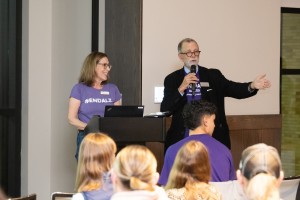
Janet Syvertsen, Senior Director of Community Engagement for the Alzheimer’s Association Hudson Valley Chapter, and Dr. Lawrence T. Force, director of Mount Saint Mary College’s Center on Aging and Disability Policy (CADP), kick off the Healthy Brain event.
Mount Saint Mary College and the Alzheimer’s Association Hudson Valley Chapter championed cognitive wellness at any age with “The Healthy Brain Experience” on Thursday, November 5.
The event took place on the Mount campus and examined practical habits for lifelong brain health, emerging medical treatments, and vital caregiver resources across Orange County and the wider Hudson Valley. It was supported in part by a grant from the New York State Department of Health.
“It’s never too early to start thinking about brain health,” said Evan Merkhofer, Vice President of Academic Affairs at the Mount. “This really aligns with who we are as Mount Saint Mary College.”
The initiative was spearheaded through a partnership between the Alzheimer’s Association Hudson Valley Chapter and the Mount’s Center on Aging and Disability Policy (CADP), directed by Lawrence T. Force, professor of Psychology. CADP promotes interdisciplinary research, educational programming, and public policy initiatives to improve the quality of life for older adults and individuals living with disabilities.
Janet Syvertsen, Senior Director of Community Engagement for the Alzheimer’s Association Hudson Valley Chapter, noted that the event was “built by students around brain health…to educate others around the campus and beyond…Tonight is a one-of-a-kind event and a pilot, and we hope it is only the beginning.”
A centerpiece of the evening was the official premiere of Healthy Brain, a short educational film produced by Mount students in the Digital Media Production II course under the direction of Merle Becker, instructor of Digital Media Production. Student director Lucas Stackpole of Manteca, Calif., alongside student producers Gabby Mastrantoni of Middletown, N.Y. and Gavin Checchi of Wappingers Falls, N.Y., worked with an all-student production crew and cast to illustrate 10 actionable, everyday habits that foster long-term brain health. These include physical activity, restful sleep, dietary adjustments, social engagement, and cognitive challenges. The students revealed that 40 percent of dementia cases worldwide may be preventable or delayed through modifiable lifestyle interventions.
Following the screening, Meg Boyce, Vice President of Programs and Services for the Alzheimer’s Association Hudson Valley Chapter, shared key Alzheimer’s research updates. She highlighted findings from the U.S. POINTER study showing that structured lifestyle interventions – including proper diet, exercise, and cognitive training – can reverse cognitive aging metrics by 1 to 2 years. Boyce also covered new FDA-approved treatments that slow disease progression by targeting brain amyloid plaques.
“I never thought I’d be able to say we can slow the progression of Alzheimer’s,” Boyce explained. “With the brain health recipe, getting younger generations on board earlier is definitely going to be what changes the trajectory moving forward.”
The evening concluded with the “Brain Health in Action” panel moderated by Nicolette Pirro of Floral Park, N.Y., a Mount Education student and on-screen personality in the Healthy Brain video. The panel featured clinical, educational, and personal perspectives from Boyce, Force, community educator Sharon Mills-Besheer, Alzheimer’s Association community representative volunteer Juan Mosos, and Mount student Hannah Lux, who shared lessons learned while working with individuals experiencing dementia at a rehabilitation center.
“Working with Alzheimer’s patients taught me how important it is to remember the person behind the diagnosis,” Lux said. “Sometimes being a good caregiver isn’t about fixing something or having all the answers. Sometimes it’s about showing up, being patient, and making someone feel safe in a world that may no longer make sense to them.”
Force urged students and families alike to take the evening’s core message into their everyday routines and family conversations. “The overarching theme is this: it’s not too late, and it’s not too early,” he explained. “But you don’t start at 60. This is precious time. Start now.”
Attendees also connected with local health organizations, wellness vendors, and campus clubs during an interactive networking showcase.