
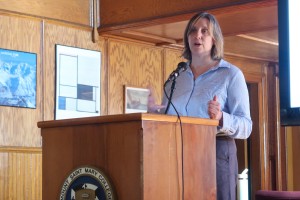
Kelly Agnew-Barajas, Director of Immigrant and Refugee Services for Catholic Charities Community Services, recently spoke at Mount Saint Mary College.
Mount Saint Mary College’s Human Services Program recently hosted Kelly Agnew-Barajas, Director of Immigrant and Refugee Services for Catholic Charities Community Services, for her presentation titled “The Human Impact of Immigration Policies” in Whittaker Hall.
The talk examined how evolving policy frameworks influence individuals and families across New York City and the Lower Hudson Valley, detailing the regional aid networks and community programs designed to assist them.
During her address, Agnew-Barajas emphasized the essential role of clear, accessible guidance in helping communities to understand their rights and avoid predatory practices. She highlighted the organization’s ongoing efforts to provide reliable legal information across the state while safeguarding vulnerable residents against deceitful schemes.
“We receive calls throughout New York State, and this is the only call center of this kind in the country,” said Agnew-Barajas, referring to the division's dedicated hotline operations. “It’s been run for more than 20 years, and it’s really something that New York State is very proud of... In addition to giving free factual legal information, we are able to take reports of immigration fraud and scams.”
Agnew-Barajas outlined the wide scope of services administered through Catholic Charities’ division. In tandem with the informational hotlines, the organization actively documents and combats predatory unauthorized legal practitioners and fraudulent online platforms that target immigrant families. The agency also coordinates comprehensive adult education, offering English language instruction, civics classes, and citizenship preparation to support long-term community integration. Additionally, case teams provide direct navigation and support for specialized groups, including survivors of human trafficking and individuals undergoing formal asylum proceedings.
She also addressed wider regulatory topics such as Temporary Protected Status (TPS), underscoring that dependable, accurate public information remains the most effective tool for families navigating complex administrative procedures. Following the lecture, attendees participated in a question-and-answer session exploring community partnerships and avenues for local advocacy.