
Important Changes to your Federal Student Loans
What is changing and why?
On July 4, 2025, Congress passed the One Big Beautiful Bill Act (OB3), which introduced major changes to the Federal Direct Loan program. These changes affect how much students can borrow, what types of loans are available, and how enrollment changes—like withdrawing from a class—can reduce your loan amount.
Loan Reduction: what happens if you drop a class?
This is one of the most important changes for ALL students to understand.
Starting July 1, 2026, your federal loan amount will be directly tied to how many credits you are enrolled in. This is called loan reduction; your loan is calculated as a proportion of your enrollment level compared to full-time.
What counts as full-time?
- Undergraduate students: 12 credits per semester
- Graduate students: 9 credits per semester
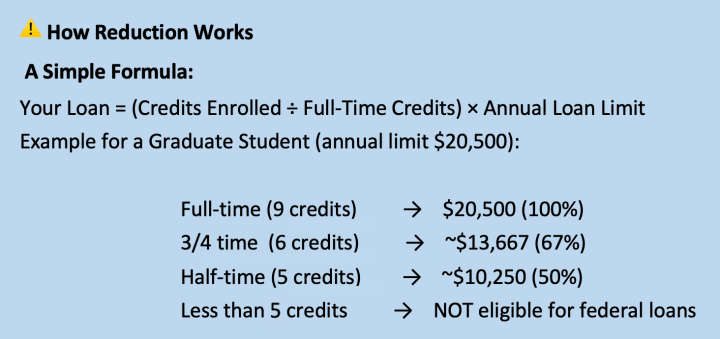
New loan limits by student type (Effective July 1, 2026)
Undergraduate Students
Good news, undergraduate Direct Loans (Subsidized and Unsubsidized) are NOT changing in annual or aggregate amounts. However, loan amount will be prorated if you enroll less than full-time.
Parent PLUS Loans — New Borrowers
- Annual limit: $20,000 per dependent student (all parents combined)
- Lifetime aggregate limit: $65,000 per dependent student
- Legacy provision: Parents who borrowed a PLUS Loan before July 1, 2026, may continue under current limits for up to 3-years or until the student completes their program, whichever comes first
- Loss of legacy: If the student completely withdraws or is not continuously enrolled, the parent loses access to legacy limits
Graduate Students — New Borrowers
- Graduate PLUS Loan: ELIMINATED as of July 1, 2026, for students who have never borrowed a federal loan at MSMC in their current program
- Unsubsidized Direct Loan: Capped at $20,500/year and $100,000 lifetime (graduate programs)
- Professional students: $50,000/year and $200,000 lifetime
- If you are both a graduate AND professional student at different points: $200,000 total lifetime cap for both combined
Graduate Students — Legacy Provision (Existing Borrowers)
You quality for the legacy provision only if:
- You had a federal Direct Loan (Unsubsidized or Grad PLUS) disbursed before July 1, 2026, AND
- You are enrolled in the same degree program at MSMC where that loan was disbursed, AND
- You remain continuously enrolled without stopping out
If you qualify, you may continue borrowing under current limits for up to 3-years or the remainder of your program, whichever is less.
Winter Interim and the Summer Semester:
- Classes taken during the winter interim session will count toward spring enrollment.
- Classes taken during the summer session will not count towards fall or spring enrollment
- Summer is considered its own term for federal student loan eligibility and loan reduction.
- Students enrolling in the summer session will have their loans reduced if they drop from full-time enrollment to less-than-full-time enrollment during the summer term.
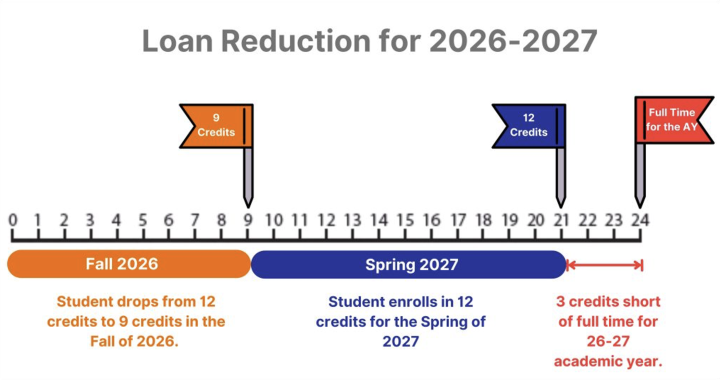
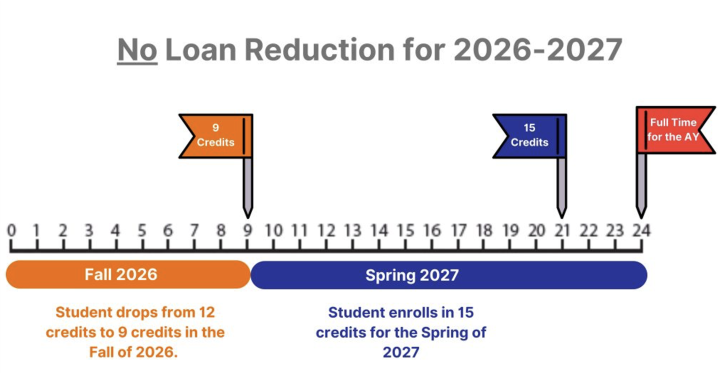
Fill-time status for undergraduate students is 24 credits for the academic year (12 per semester)
A student who drops to 9 credits in the fall semester and maintains 12 credits for the spring semester will be 3 credits short of being considered full-time for the academic year. Due to this 3 credit shortage, the student's federal loans must be reduced.
A student who drops to 9 credits in the fall semester and increases their enrollment to 15 credits for the spring semester, will be considered full-time for the academic year. Since the student met the full-time requirements for the academic year, their loans do not have to be reduced.
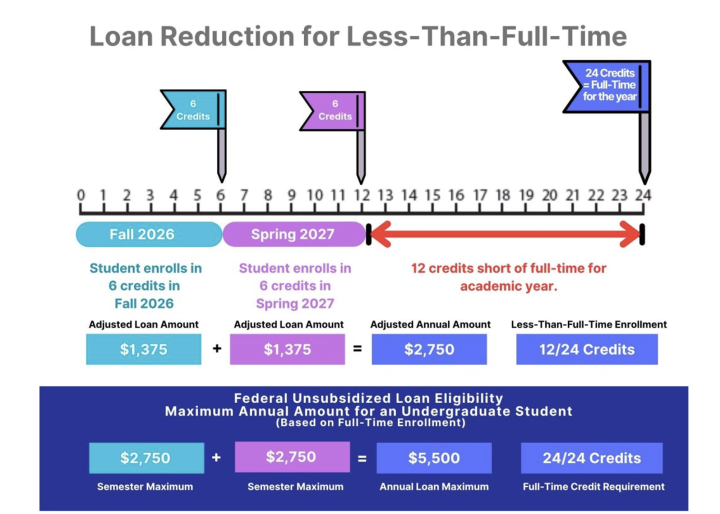
Full-time status for undergraduate students is 24 credits for the academic year (12 per semester)
A first-year student who enrolls in 6 credits in the fall semester and also enrolls in 6 credits for the spring semester, will be 12 credits short of being considered full-time for the academic year. Due to this 12-credit shortage, the student's federal loans must be reduced.
What msmc is doing to help you
MSMC is committed to making sure every student understands these changes before they affect your borrowing. Here is what we are doing:
- Reviewing all student program classifications to ensure accurate loan type assignment
- Communicating directly with current borrowers about changes that affect their specific situation
- Exploring private lending options for students who may need to bridge funding gaps beyond the new federal limits - updated information will be available on our website
- Continuously updating the guidance as the U.S. Department of Education releases final implementation rules
FAQ
Yes, it is very important that you come speak with the Student Financial Services office before making any changes to your schedule (adding or withdrawing from courses), as this could change your loan eligibility.
No, waitlisted courses do not count toward your enrollment until you are officially registered.
Possibly. If you later enroll in enough additional credits during the same academic year to return to full-time annual enrollment, your loan eligibility may be recalculated before the next disbursement. For example, a student who drops three credits during the fall but adds three additional credits during the spring can return to 24 completed credits for the academic year and may receive their full annual Direct Loan eligibility.
Yes, all students who borrow federal loans are affected by this new policy.
No, at Mount Saint Mary College we follow all federal regulations, so no student will be able to “appeal” this policy.
Possibly, you need to speak with student financial services about how your aid is being affected if you drop or add classes.